IT Cyber Security:
The Cyber Security Imperative — A Battle Every Organisation Is Already Fighting
Cyber security is no longer a technology problem confined to the IT department — it is a board-level business risk that determines organisational survival. In 2024, the average cost of a data breach globally reached USD 4.88 million — the highest figure ever recorded. Ransomware payments exceeded USD 1 billion for the first time in a single year. The average time for an attacker to move laterally from initial compromise to critical systems dropped to under 62 minutes. Nation-state threat actors, organised cybercriminal groups, and opportunistic hackers are operating with sophistication, persistence, and resources that were unimaginable a decade ago.
Every organisation connected to a network — regardless of industry, size, or geography — is a potential target. Healthcare systems are attacked to extort ransom from organisations that cannot afford patient record downtime. Manufacturing plants are targeted to disrupt supply chains and force competitor advantage. Financial institutions are breached to harvest credentials, enable fraud, and conduct market manipulation. Government agencies face persistent intrusions by nation-state actors seeking intelligence, influence, or infrastructure sabotage capabilities. And small and medium businesses — often the weakest link in supply chains — are compromised specifically because their larger partners have stronger defences.
The challenge for technology leaders is not whether to invest in cyber security — that question was settled long ago. The challenge is how to invest strategically: how to build a layered, integrated security architecture that addresses the full threat landscape without creating operational paralysis, how to choose security platforms that provide genuine protection rather than compliance checkbox coverage, and how to build the organisational capability — the people, processes, and technology — required to detect, respond to, and recover from the inevitable security incidents that every organisation will face.
At Kayaara Innovations Pvt Ltd, we design and implement enterprise cyber security architectures that are built on the Defence-in-Depth principle: multiple overlapping layers of security controls that ensure no single point of failure can result in catastrophic compromise. This blog is our comprehensive guide to today’s cyber security challenges and the platforms and solutions that deliver genuine, measurable security improvement.
“There are two kinds of organisations: those that have been breached, and those that do not yet know they have been breached. Cyber security is not about achieving perfect prevention — it is about minimising the likelihood of compromise, minimising the impact when compromise occurs, and maximising the speed of detection and recovery.”
The Modern Threat Landscape: Eight Attack Categories That Define Today’s Risk :
Before building a security architecture, organisations must understand the threat landscape they are defending against. Security controls designed to stop yesterday’s threats while today’s attackers exploit undefended vectors are a dangerous form of false confidence. The eight categories below represent the dominant attack vectors that enterprise security architectures must address in 2025 and beyond.
The Most Financially Devastating Threat :
Ransomware has evolved from a nuisance into a sophisticated, industrialised criminal enterprise. Modern ransomware groups operate Ransomware-as-a-Service (RaaS) models — providing ransomware tools, infrastructure, and negotiation services to criminal affiliates in exchange for a share of ransom payments. The double extortion model — encrypting victim data while simultaneously exfiltrating it and threatening publication — has made paying the ransom the only option for many organisations, even when backups are available.
- Ransomware attack chain — Initial access (typically through phishing, VPN vulnerability exploitation, or RDP brute force), lateral movement across the network (often taking days to weeks of reconnaissance before deployment), privilege escalation to domain administrator level, data exfiltration to attacker-controlled infrastructure, encryption deployment across all accessible systems simultaneously.
- Ransomware defence priorities — immutable, air-gapped backups that cannot be encrypted by ransomware running on compromised hosts; privileged access management to prevent attackers from gaining the domain administrator credentials required for network-wide deployment; endpoint detection and response with rollback capability; network segmentation to limit lateral movement; and regular, timed recovery drills to validate that backup data can actually be restored within acceptable timeframes.
- Notable 2024 ransomware impacts — healthcare systems disrupted for weeks with patient care diverted; manufacturing plants shut down at cost of millions per day; logistics companies unable to process shipments; government agencies forced to revert to manual paper-based processes. The operational impact of ransomware consistently exceeds the ransom demand itself.
Phishing, Spear-Phishing, and Business Email Compromise (BEC) :
Phishing remains the most successful initial access vector for both opportunistic and targeted attacks, accounting for over 41% of all cyber incidents in 2024. The sophistication of modern phishing has advanced dramatically — AI-generated phishing emails are now indistinguishable in quality from legitimate communications, deepfake video and audio impersonation of executives has enabled fraudulent wire transfer authorisation, and highly personalised spear-phishing attacks leverage social media research to create convincing pretexts.
- Business Email Compromise (BEC) — attackers compromise or impersonate executive email accounts to authorise fraudulent payments, redirect payroll deposits, or manipulate vendor payment details. BEC caused USD 2.9 billion in losses in the United States alone in 2023, making it the highest-loss category of cybercrime by financial impact despite requiring no malware or technical exploitation.
- Vishing and smishing — voice phishing (vishing) and SMS phishing (smishing) have become primary channels for credential theft as email security has improved. Attackers call employees impersonating IT helpdesk, HR, or executive assistants to extract credentials or manipulate victims into installing remote access tools.
- Deepfake-enabled social engineering — generative AI now enables real-time voice cloning and video deepfakes that allow attackers to impersonate executives in video calls with sufficient realism to convince victims. Several high-profile BEC cases involving deepfake video calls resulted in multi-million dollar transfers in 2024.
Zero-Day Exploits and Supply Chain Attacks
Zero-day vulnerabilities — security flaws that are unknown to the software vendor and therefore have no available patch — are among the most valuable commodities in the cyber threat economy. Nation-state intelligence agencies and well-funded criminal groups maintain stockpiles of zero-day exploits for use against high-value targets. Supply chain attacks — compromising the software development, build, or distribution infrastructure of widely-used technology products — enable attackers to deliver malicious code to thousands of organisations simultaneously through a single trusted supplier.
- SolarWinds, Log4Shell, MOVEit, and beyond — supply chain attacks have demonstrated that the most sophisticated attacks no longer target organisations directly but target the tools and infrastructure those organisations trust. The compromised SolarWinds Orion update delivered backdoors to 18,000 organisations. The Log4j vulnerability in a widely-used Java library exposed hundreds of millions of systems to remote code execution.
- Software supply chain security — organisations must extend their security assessment beyond their own systems to their software supply chains. Software Composition Analysis (SCA) tools identify open-source components with known vulnerabilities. SBOM (Software Bill of Materials) requirements are becoming mandatory in regulated sectors. Vendor security assessment programmes must include software suppliers alongside traditional IT service providers.
Insider Threats and Privilege Abuse :
Insider threats — security incidents caused by current or former employees, contractors, or business partners with authorised access to organisational systems — are among the most difficult threats to detect and prevent, because the attacker starts from inside the security perimeter with legitimate credentials. Insider threats range from malicious actors deliberately exfiltrating data for financial gain or competitive espionage, to negligent employees who inadvertently expose sensitive data through careless data handling.
- Insider threat detection — User and Entity Behaviour Analytics (UEBA) — built into modern SIEM platforms — uses machine learning to establish baseline behaviour profiles for individual users and alert on significant deviations. An employee downloading 10 times their normal volume of documents in the week before resignation is a statistically significant anomaly that warrants investigation.
- Least privilege enforcement — the most effective preventive control for insider threats is ensuring that every user has access only to the systems and data required for their current role. Regular access reviews, automatic deprovisioning when roles change, and just-in-time access for elevated privileges dramatically limit the potential impact of insider misuse.
Threat Reality Check: In 2024, the average attacker dwell time — the period between initial compromise and detection — was 24 days. During those 24 days, attackers conducted reconnaissance, escalated privileges, moved laterally across the network, identified valuable data, and established persistence mechanisms — all while appearing as routine network traffic. Speed of detection is the primary determinant of breach severity.
IT Cyber Security Architecture: The Complete Defence-in-Depth Framework
The architecture diagram below presents the complete enterprise cyber security framework — from the modern threat landscape through four defence layers: perimeter and network security, identity and endpoint protection, cloud and application security, and SOC operations with incident response — down to the measurable security outcomes every organisation should target.
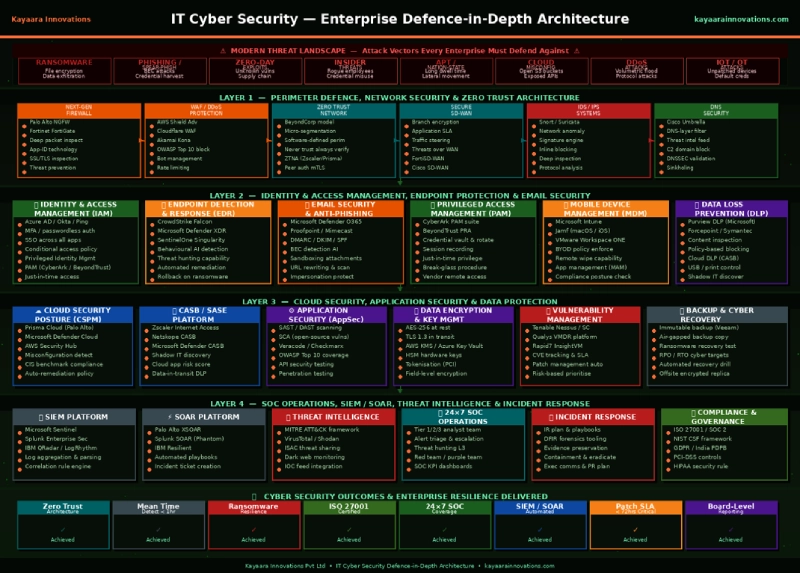
IT Cyber Security — Enterprise Defence-in-Depth Architecture — Kayaara Innovations :
The Defence-in-Depth architecture illustrated above ensures that no single security control failure results in catastrophic compromise. Each layer provides independent protection while also serving as a detection point for threats that have bypassed or compromised the layer above it. Attackers who breach the perimeter encounter identity controls. Those who compromise a user identity encounter endpoint detection. Those who reach the network encounter segmentation and anomaly detection. Those whose activity is not blocked encounter SIEM correlation and SOC analysts. This overlapping, redundant design is the only architecture that provides genuine security resilience against sophisticated modern threats.
Challenge #1: Building a Zero Trust Security Architecture
The traditional perimeter-based security model — the metaphor of a hard shell around a soft interior — has been definitively broken by cloud computing, mobile workforces, third-party integrations, and the sheer sophistication of modern attackers. When the network perimeter is dissolved by cloud services and remote access, and when attackers routinely operate with legitimate credentials obtained through phishing or credential theft, trusting any connection based solely on its network origin is no longer a defensible security posture.
Zero Trust Architecture (ZTA) — the security model built on the principle of “never trust, always verify” — requires that every access request, from every user, device, and application, regardless of network location, be authenticated, authorised, and continuously validated before access to any resource is granted. Zero Trust does not mean trusting nothing — it means earning trust through verified identity, device health, context, and behaviour, rather than assuming trust based on network location.
Zero Trust Principles in Practice :
- Verify explicitly — always authenticate and authorise based on all available data points: user identity (with MFA), device health and compliance status, location and IP reputation, application sensitivity, time of day and access patterns, and risk signals from threat intelligence feeds. No single factor — not even a valid username and password — should be sufficient to grant access to sensitive resources.
- Use least-privilege access — every user, service, and application receives only the minimum access required to perform its function. Access is scoped to specific resources, specific actions, and specific time windows where possible. Just-in-time access provisioning — granting elevated privileges for the duration of a specific task and automatically revoking them upon completion — is the gold standard for privileged access management.
- Assume breach — design security systems on the assumption that attackers are already inside the network. This means segmenting the network so that a compromise of one segment cannot automatically enable compromise of others, encrypting data in transit between all internal services (not just at the perimeter), monitoring all internal traffic for anomalous patterns, and maintaining the capability to detect, respond to, and recover from incidents that bypass preventive controls.
- Micro-segmentation — divide the network into small, isolated zones with explicit access controls between zones. A workstation in the finance department should not be able to communicate directly with servers in the engineering department — all traffic should traverse a security inspection point that can detect and block lateral movement attempts.
- Continuous validation — Zero Trust is not a one-time authentication event. Access sessions should be continuously re-evaluated against risk signals throughout their duration. Anomalous behaviour detected mid-session (rapid data download, access from a new geographic location, unusual application interaction patterns) should trigger step-up authentication or automatic session termination.
Zero Trust Platform Solutions :
- Zscaler Zero Trust Exchange — cloud-native ZTNA platform that routes all user traffic through Zscaler’s cloud inspection fabric, applying consistent security policy to all users regardless of location. Eliminates the need for traditional VPN and provides application-level access rather than network-level access, significantly limiting attacker lateral movement opportunities after credential compromise.
- Palo Alto Prisma Access — SASE (Secure Access Service Edge) platform combining SD-WAN, ZTNA, CASB, and NGFW capabilities in a cloud-delivered service. Provides consistent security policy enforcement across all users, devices, applications, and locations through a globally distributed cloud infrastructure.
- Microsoft Entra / Azure AD Conditional Access — Microsoft’s identity-centric Zero Trust implementation. Conditional access policies evaluate dozens of risk signals (user risk, sign-in risk, device compliance, location, application sensitivity) and dynamically require step-up authentication, block access, or enforce compliance remediation based on calculated risk.
- Illumio Core — micro-segmentation platform that applies application-aware security policies at the workload level, independent of network infrastructure. Particularly effective in hybrid cloud environments where workloads span on-premise data centres, public cloud, and containerised environments.
Zero Trust ROI:
Organisations that have implemented mature Zero Trust architectures report 50% reduction in the blast radius of security incidents (the proportion of the environment affected when a compromise occurs), 37% reduction in the cost of security breaches, and 40% faster incident containment time compared to perimeter-based security architectures. Zero Trust is the single highest-impact security architecture investment available to enterprises today.
Challenge #2: Identity and Access Management — The New Security Perimeter
Identity has replaced the network as the primary security perimeter. In a cloud and mobile world, the ability to verify who is accessing what, from where, on which device, and whether that access is legitimate given all available context is the foundational security capability upon which all other controls depend. Organisations with weak identity security consistently suffer the majority of their security incidents through compromised credentials — because an attacker with valid credentials can bypass most perimeter and network controls that were designed to stop unknown attackers, not authorised users.
The Identity and Access Management (IAM) challenge is not merely technical — it is organisational. Identity security spans every system, every user, every third-party relationship, and every application in the enterprise. Implementing it comprehensively requires sustained investment in technology, process design, and organisational change management that most organisations underestimate at the outset.
Multi-Factor Authentication — The Single Highest-Impact Security Control :
Microsoft’s research consistently finds that MFA blocks over 99.9% of automated credential-stuffing and password spray attacks. Despite this, as many as 40% of enterprise users still operate without MFA on critical systems. The failure to enforce MFA universally is one of the most prevalent and consequential security gaps in enterprise environments — and one of the most straightforward to close.
- Phishing-resistant MFA — traditional TOTP (time-based one-time password) MFA codes can be intercepted through real-time phishing attacks where victims are tricked into entering their code on an attacker-controlled site. Phishing-resistant MFA methods — FIDO2 security keys (YubiKey, Google Titan Key), Windows Hello for Business, and passkey authentication — bind the authentication to the specific site being accessed and cannot be captured and replayed on a different site.
- Passwordless authentication — the future of enterprise authentication replaces passwords entirely with phishing-resistant authenticators. Microsoft Authenticator passwordless, Apple Face ID / Touch ID with passkeys, and hardware security keys provide stronger security than even complex passwords combined with TOTP MFA, while simultaneously improving user experience by eliminating the friction of password management.
- MFA fatigue attacks — attackers who have obtained valid credentials abuse MFA push notification systems by sending repeated authentication requests until the frustrated user approves one. Defences include number matching in push notifications (the user must match a number displayed in the application to the number shown in the push notification), geographic anomaly detection, and request rate limiting that triggers account lockout after a defined number of denied push notifications.
Privileged Access Management (PAM) :
Privileged accounts — system administrators, database administrators, network engineers, security operations staff, and any account with elevated access to critical systems — are the highest-value targets in any enterprise. Compromise of a single privileged account can enable an attacker to access, exfiltrate, or destroy the organisation’s most sensitive data and critical infrastructure. PAM controls are therefore among the highest-priority security investments for any organisation.
- CyberArk Privileged Access Manager — the market-leading PAM platform. CyberArk vaults all privileged credentials, providing just-in-time checkout of credentials for specific sessions that are automatically rotated upon session completion. All privileged sessions are recorded, monitored for anomalous behaviour, and can be terminated immediately if suspicious activity is detected.
- BeyondTrust Privileged Remote Access — specialised PAM for secure vendor and contractor remote access. Eliminates the need for VPN access for third parties, provides session recording and monitoring for all external privileged sessions, and enables real-time session observation and termination.
- Just-In-Time (JIT) access — privileged access granted only for the duration of specific, approved tasks. A database administrator should not have permanent administrative access to production databases — they should request access for a specific task, receive time-limited credentials, and have that access automatically revoked upon task completion. JIT access eliminates the standing privilege that makes privileged account compromise catastrophic.
Identity Security Statistic: According to Verizon’s 2024 Data Breach Investigations Report, 74% of all breaches involve the human element — either stolen credentials, phishing, or abuse of privileges. Identity is the primary attack surface. Organisations that prioritise identity security — MFA, PAM, UEBA, and least-privilege access — consistently achieve the greatest reduction in breach risk per security dollar invested.
Challenge #3: Endpoint Security and Extended Detection & Response (XDR)
Every endpoint — laptop, desktop, server, mobile device, cloud workload, and IoT device — is a potential entry point for attackers and a potential staging point for lateral movement within the network. Traditional antivirus, which relied on signature matching against known malware samples, was effective against the threat landscape of 2005. Against modern attackers who use custom malware, fileless techniques, living-off-the-land attacks (using legitimate system tools like PowerShell and WMI to execute malicious actions), and AI-generated polymorphic code that changes its signature with every execution, signature-based antivirus provides almost no protection.
Endpoint Detection and Response (EDR) — The Modern Endpoint Security Standard
EDR platforms replace signature-based antivirus with behavioural AI that analyses the complete sequence of activities on an endpoint — process creation, file system access, registry modifications, network connections, memory operations, and user interactions — to identify patterns that indicate malicious activity, regardless of whether the specific malware variant has been seen before.
- CrowdStrike Falcon — the market-defining EDR platform. Falcon’s cloud-native architecture enables real-time threat detection across millions of endpoints simultaneously. Falcon’s AI engine detects ransomware and other malware based on behavioural patterns before encryption begins, and Falcon’s threat graph correlates activity across all CrowdStrike-protected endpoints globally to identify emerging attack patterns. Falcon’s threat hunting service provides access to CrowdStrike’s elite threat hunters who proactively search for attacker presence within customer environments.
- Microsoft Defender XDR — the endpoint security platform integrated with Microsoft 365 and Azure. Defender XDR correlates signals across endpoints (Defender for Endpoint), email (Defender for Office 365), identity (Defender for Identity), cloud apps (Defender for Cloud Apps), and cloud workloads (Defender for Cloud) into a unified threat picture. For organisations already invested in the Microsoft ecosystem, Defender XDR provides exceptional security value relative to its additional cost.
- SentinelOne Singularity — autonomous endpoint protection platform with industry-leading automated response capabilities. SentinelOne can autonomously detect, contain, and remediate threats without requiring human analyst intervention, including automatically rolling back ransomware-encrypted files using its Storyline Active Response (STAR) engine.
- Behavioural AI vs signature detection — behavioural AI analyses sequences of system calls, file operations, network connections, and process relationships over time to identify patterns that match known attack techniques regardless of the specific malware variant. This approach detects novel malware, fileless attacks, and living-off-the-land techniques that bypass traditional signature detection entirely.
Extended Detection and Response (XDR) — Beyond the Endpoint
XDR extends EDR’s telemetry collection and correlation from endpoints to all security data sources — network traffic, email, cloud workloads, identity events, and application logs — correlating signals across all these sources to detect multi-stage attacks that would be invisible when any single data source is analysed in isolation. A phishing email that delivers a credential-harvesting link, followed by an authentication with the harvested credentials from an unusual geographic location, followed by unusual data access patterns — is a three-event sequence that spans email security, identity, and SIEM. XDR correlates these events automatically into a single incident requiring investigation.
- Palo Alto Cortex XDR — the leading XDR platform, correlating data from endpoints, network, cloud, and third-party sources into unified incidents. Cortex XDR’s behavioural analytics engine detects sophisticated attacks that evade traditional detection, while its automated investigation capability significantly reduces the analyst effort required to understand and respond to complex incidents.
- Microsoft Sentinel with Defender XDR — the Microsoft SIEM and XDR combination. Sentinel ingests and correlates data from the entire Microsoft security stack plus third-party sources, with built-in AI-powered analytics, automated investigation and response (SOAR), and threat hunting capabilities. Best for Microsoft-centric security ecosystems.
EDR Effectiveness Benchmark: Organisations with mature EDR deployments detect threats in an average of 6 hours, compared to 197 days without EDR. EDR platforms with automated response capabilities reduce the mean-time-to-contain security incidents by 88% compared to environments relying on manual analyst response. The investment in EDR consistently delivers the highest detection and response improvement per security dollar spent.
Challenge #4: Cloud Security — Protecting the Distributed Enterprise
The migration of workloads, data, and applications to cloud environments has fundamentally changed the security challenge. The security controls that protected on-premise environments — perimeter firewalls, network-based intrusion detection, physical access controls — provide no protection for cloud-hosted resources. Cloud security requires a completely different set of tools, disciplines, and mental models, and organisations that attempt to apply on-premise security thinking to cloud environments consistently create significant security gaps.
The cloud security challenge is compounded by the shared responsibility model — cloud providers secure the underlying infrastructure, but customers are responsible for securing everything built on top of that infrastructure. Misconfigurations — incorrectly permissive security settings, unencrypted storage, overly permissive IAM roles, exposed management interfaces — are the primary cause of cloud security incidents, and they are entirely within the customer’s responsibility and control.
Cloud Security Posture Management (CSPM)
CSPM platforms continuously scan cloud environments for security misconfigurations, compliance violations, and security risks, providing real-time visibility into the security posture of all cloud resources across all cloud providers:
- Palo Alto Prisma Cloud — the most comprehensive CSPM platform in the market. Prisma Cloud provides cloud security posture management, cloud workload protection, cloud network security, cloud infrastructure entitlement management (CIEM), and cloud code security (Infrastructure as Code scanning) in a unified platform. Multi-cloud support across AWS, Azure, GCP, and OCI.
- Microsoft Defender for Cloud — native cloud security posture management for Azure, with extended support for AWS and GCP through Azure Arc. Tightly integrated with Microsoft Sentinel for alert correlation and automated response. Best for Azure-primary organisations already invested in the Microsoft security ecosystem.
- AWS Security Hub — AWS-native security posture management that aggregates findings from AWS-native security services (GuardDuty, Inspector, Macie) and third-party security tools into a unified security view. Essential for AWS-primary organisations as the centralised security findings aggregator.
- CIS Benchmark compliance — CSPM platforms evaluate cloud resource configurations against CIS (Centre for Internet Security) benchmarks — industry-consensus best practice configuration standards for cloud services. Organisations that maintain CIS benchmark compliance for their cloud environments consistently achieve significantly lower rates of security incidents driven by misconfiguration.
Cloud Access Security Broker (CASB) and SASE :
As organisations adopt SaaS applications at scale, traditional network-based security controls cannot inspect or enforce policies on traffic between users and SaaS applications. CASB and SASE platforms provide security visibility and control for cloud application usage:
- Zscaler Internet Access (ZIA) — cloud-delivered secure web gateway that routes all user internet traffic through Zscaler’s inspection fabric, applying URL filtering, malware scanning, DLP policies, and advanced threat protection to all internet-bound traffic regardless of user location. Eliminates the need to backhaul remote user traffic through the corporate network for security inspection.
- Netskope CASB — leading CASB platform providing deep visibility and control over SaaS application usage. Netskope’s inline proxy inspects all SaaS traffic in real-time, applying data loss prevention policies, detecting sensitive data uploads to unsanctioned applications (shadow IT), and enforcing usage policies that the SaaS application itself cannot enforce.
- Microsoft Defender for Cloud Apps — Microsoft’s CASB integrated with the Microsoft 365 security stack. Provides API-based integration with thousands of SaaS applications for policy enforcement, user activity monitoring, and threat detection. Best for organisations where Microsoft 365 is the primary SaaS platform.
Cloud Security Priority: The single most impactful cloud security action most organisations can take is enabling comprehensive audit logging across all cloud services — AWS CloudTrail and GuardDuty, Azure Activity Log and Defender for Cloud, GCP Cloud Audit Logs and Security Command Centre — and routing all security events to a centralised SIEM from day one. Organisations that enable logging after an incident lose all pre-incident evidence. Enable it before any workloads move to cloud.
Challenge #5: Security Operations Centre (SOC) — Building the Cyber Defence Command Centre
Security controls — firewalls, EDR, SIEM, identity platforms — generate enormous volumes of security alerts. An average enterprise SIEM receives millions of log events per day and generates thousands of security alerts per week. Without a skilled team capable of triaging, investigating, and responding to these alerts, the investment in detection technology delivers no security value. The Security Operations Centre (SOC) is the human intelligence layer that transforms raw security telemetry into meaningful threat detection and response capability.
SIEM — The Brain of the Security Operations Centre
The Security Information and Event Management (SIEM) platform is the central nervous system of the SOC. It ingests log data and security events from every system in the environment — firewalls, endpoints, identity systems, cloud platforms, applications, and network infrastructure — correlates events across these sources using detection rules and machine learning analytics, and presents prioritised, contextualised alerts to SOC analysts for investigation.
- Microsoft Sentinel — cloud-native SIEM with built-in AI analytics, threat intelligence integration, and SOAR capabilities. Sentinel’s cost model (pay-per-GB of ingested data) is more predictable than traditional SIEM licensing, and its native integration with the Microsoft security ecosystem reduces integration effort for Microsoft-centric organisations. Built-in ML analytics detect anomalies without requiring custom rule development. Best for organisations with significant Microsoft investment.
- Splunk Enterprise Security — the most mature and flexible SIEM platform. Splunk’s powerful search language (SPL) enables sophisticated custom detection logic, and its ecosystem of threat intelligence integrations and third-party apps is unmatched. Splunk requires significant investment in both licensing and skilled administration, but delivers unparalleled flexibility for complex detection requirements. Best for large enterprises with diverse technology environments and skilled security engineering teams.
- IBM QRadar — established enterprise SIEM with strong network flow analysis capabilities. QRadar’s correlation engine and offense management workflow are well-regarded for high-volume enterprise environments. IBM’s threat intelligence integration (X-Force) provides quality threat context for alert triage.
- UEBA (User and Entity Behaviour Analytics) — the AI component of modern SIEM platforms that establishes baseline behaviour profiles for individual users, service accounts, and network entities, and alerts on statistically significant deviations from baseline. UEBA detects compromised accounts, insider threats, and APT lateral movement that rule-based detection misses.
SOAR — Automating the SOC Response
Security Orchestration, Automation, and Response (SOAR) platforms automate repetitive SOC tasks — alert triage, threat intelligence lookups, indicator blocking, ticket creation, and common investigation steps — freeing analysts to focus on complex investigations that require human judgment. SOAR is the multiplier that allows a SOC team to handle alert volumes that would otherwise require many more analysts:
- Palo Alto XSOAR (Cortex XSOAR) — the leading SOAR platform. XSOAR’s playbook engine automates complex multi-step response workflows across hundreds of integrated security tools. A phishing investigation playbook, for example, automatically extracts URL and attachment indicators from the reported email, queries threat intelligence sources, detonates attachments in a sandbox, blocks malicious indicators at the firewall and email gateway, identifies all users who received the same email, and creates a ticket with complete investigation context — in under two minutes, without analyst intervention.
- Splunk SOAR (formerly Phantom) — deep integration with Splunk SIEM. SOAR playbooks trigger automatically from Splunk Notable Events, enriching alerts with threat intelligence context and executing initial containment actions before an analyst reviews the alert.
- Mean-time-to-respond reduction — mature SOAR implementations consistently reduce mean-time-to-respond (MTTR) to security incidents by 70-90%, from hours to minutes for common incident types. The financial value of this improvement — measured in reduced breach cost through faster containment — consistently exceeds the SOAR platform investment within the first year of deployment.
Threat Intelligence — Knowing Your Enemy
Threat intelligence — contextual knowledge about current attacker tools, techniques, motivations, and indicators — transforms security operations from reactive to proactive. SOC analysts who understand the specific threat actors targeting their industry, the specific malware families those actors use, and the specific indicators associated with current campaigns can identify threats much faster and with much higher confidence than analysts working without this context:
- MITRE ATT&CK Framework — the industry-standard taxonomy of attacker techniques, organised into 14 tactical categories from initial access through impact. MITRE ATT&CK provides a common language for describing attacker behaviour, a structured framework for mapping detection coverage gaps, and a reference architecture for threat hunting programmes. Every SIEM detection rule should be mapped to the specific ATT&CK techniques it detects.
- Threat intelligence platforms — commercial threat intelligence platforms (Recorded Future, Mandiant Advantage, CrowdStrike Falcon Intelligence) provide curated, contextualised intelligence on current threat campaigns, emerging vulnerabilities, and threat actor profiles. This intelligence enriches SIEM alerts with actor attribution and context, and informs proactive hunting for specific threat actor indicators.
- Dark web monitoring — commercial dark web monitoring services scan criminal forums, marketplaces, and closed channels for mentions of the organisation’s brand, domain names, executive names, and credential databases. Early warning of credential exposure through dark web monitoring enables proactive password resets before compromised credentials are used in attacks.
SOC Maturity Benchmark: Level 1 SOC (reactive alert triage) reduces breach cost by approximately 20% compared to no SOC. Level 2 SOC (proactive threat hunting, SOAR automation) reduces breach cost by approximately 45%. Level 3 SOC (predictive intelligence-led operations, red team programme, purple teaming) reduces breach cost by approximately 65%. Each maturity level delivers significant incremental value, and the journey from Level 1 to Level 3 is achievable within 24-36 months with appropriate investment.
Challenge #6: Cyber Resilience — Backup, Disaster Recovery, and Incident Response
Prevention fails. Even the most sophisticated, well-resourced security programme will eventually face a security incident that bypasses its preventive controls. The difference between a security incident that causes temporary disruption and one that causes existential business damage is almost entirely determined by the organisation’s preparation for response and recovery. Cyber resilience — the capability to detect, respond to, contain, and recover from security incidents rapidly and systematically — is as important as prevention in the modern security architecture.
Ransomware-Resilient Backup Architecture
Traditional backup systems are frequently among the first targets for ransomware operators, who encrypt or delete backup data before deploying their ransomware payload to ensure that victims cannot recover without paying ransom. A ransomware-resilient backup architecture requires specific design choices that go beyond standard backup best practices:
- Immutable backups — backup data stored in a format that cannot be modified, deleted, or encrypted by any account operating on connected systems. Cloud-based immutable storage (AWS S3 Object Lock, Azure Immutable Blob Storage, Wasabi Object Lock) provides technically enforced immutability independent of the security of the backup server or administrator credentials.
- Air-gapped backup copies — at least one copy of backup data must be stored in a system that has no persistent network connection to the production environment. Tape-based offline storage, physically disconnected storage systems, and cloud storage with time-delayed replication all provide varying degrees of air-gap protection.
- 3-2-1-1-0 backup rule — the modern evolution of the traditional 3-2-1 rule: 3 copies of data, on 2 different media types, with 1 offsite copy, 1 offline/immutable copy, and 0 errors verified through regular restoration testing.
- Recovery time validation — backup systems that have never been tested for recovery provide false confidence. Organisations must regularly execute timed recovery drills — restoring complete systems from backup in a test environment — and verify that recovery time objectives are achievable. Many organisations discover during a ransomware incident that their backup data is intact but their recovery time is measured in weeks, not hours.
Incident Response Planning and Execution
An incident response plan that exists only as a document in a filing system provides almost no value during an actual security incident. Incident response capability must be rehearsed, validated, and refined through regular tabletop exercises and technical simulations before it is needed under pressure:
- Incident Response Plan (IRP) — document the complete incident response process: detection and initial triage, containment and isolation, eradication and remediation, recovery and restoration, and post-incident review. The IRP must include specific playbooks for the most probable incident types: ransomware, data breach, BEC fraud, DDoS attack, and insider threat.
- Tabletop exercises — quarterly exercises where the incident response team and business leadership work through realistic attack scenarios without executing technical response actions. Tabletop exercises reveal gaps in communication, decision-making authority, and inter-team coordination that technical rehearsals cannot expose.
- Digital forensics capability — the ability to preserve, collect, and analyse evidence from compromised systems is essential both for understanding how a breach occurred and for regulatory notification obligations. Organisations that destroy forensic evidence through improper containment actions face both analytical blindness and potential regulatory exposure.
- Regulatory notification obligations — most data protection regulations (GDPR, India PDPB, HIPAA, PCI-DSS) impose mandatory breach notification obligations with defined timelines (GDPR requires notification within 72 hours of awareness). Incident response plans must include explicit regulatory notification procedures with defined escalation paths and legal review requirements.
Resilience Truth: The organisations that recover fastest from ransomware attacks are not necessarily those with the best preventive security — they are those that invested in tested, ransomware-resilient backup architectures and rehearsed their incident response procedures before they needed them. Cyber resilience is a discipline that must be built during peacetime. There is no time to design a recovery architecture during a live ransomware incident.
Challenge #7: Compliance, Governance, and Security Risk Management
Cyber security compliance — demonstrating to regulators, customers, partners, and boards that the organisation’s security controls meet applicable standards and frameworks — is both a regulatory obligation and a market necessity. Organisations that cannot demonstrate security compliance lose business, fail regulatory audits, and face fines and enforcement actions. But compliance is not security: organisations that achieve compliance certification without building genuine security capability create a dangerous false confidence.
Security Frameworks and Standards
- NIST Cybersecurity Framework (CSF) 2.0 — the US National Institute of Standards and Technology’s cybersecurity framework, now in its second major revision. NIST CSF provides a risk-based approach to managing cyber security through five functions — Identify, Protect, Detect, Respond, and Recover — with a new Govern function added in CSF 2.0 that emphasises executive accountability. Widely adopted as the reference framework for enterprise security programmes globally, including in Indian organisations with international operations.
- ISO 27001:2022 — the international standard for Information Security Management Systems (ISMS). ISO 27001 certification demonstrates to customers and partners that the organisation has implemented a comprehensive, audited information security management system. Certification requires formal risk assessment, implementation of appropriate controls from Annex A, and annual third-party audits. Increasingly mandatory for suppliers to regulated industries and government agencies.
- India DPDP Act 2023 (Digital Personal Data Protection Act) — India’s comprehensive data protection regulation, imposing obligations on organisations that process personal data of Indian residents. Requirements include data minimisation, purpose limitation, consent management, breach notification (within 72 hours), and appointment of a Data Protection Officer for significant data processors. Organisations processing sensitive personal data face the most stringent requirements.
- PCI-DSS 4.0 — the Payment Card Industry Data Security Standard, governing all organisations that store, process, or transmit payment card data. PCI-DSS 4.0 introduces significant new requirements including authenticated scanning, customised security approaches for novel technologies, and enhanced multi-factor authentication requirements.
- SEBI Cybersecurity Framework — the Securities and Exchange Board of India’s comprehensive cybersecurity and cyber resilience framework for regulated entities including stock exchanges, depositories, brokers, and mutual funds. Mandates specific security controls, SOC establishment, vulnerability assessment frequencies, and incident reporting requirements.
Security Risk Management and Board Reporting
Effective cyber security governance requires translating technical security metrics into business risk language that boards and senior executives can understand and act on. Boards that receive security reports consisting of technical metrics (CVE counts, patch compliance percentages, SIEM alert volumes) without business risk context consistently fail to make appropriately informed resource allocation decisions:
- Cyber risk quantification — frameworks like FAIR (Factor Analysis of Information Risk) provide structured methodologies for quantifying cyber risk in financial terms — expressing the probability and potential financial impact of security scenarios in the same language used for all other business risks.
- Security metrics dashboard — board-level security reporting should cover: overall security posture trend (improving, stable, or deteriorating), top three current security risks and their status, recent significant incidents and their business impact, compliance certification status, critical vulnerability remediation velocity, and security investment ROI compared to industry benchmarks.
- Third-party risk management — supply chain security has become one of the most significant security challenges for large organisations. Third-party risk management programmes systematically assess the security posture of all suppliers, partners, and contractors with access to the organisation’s systems or data, and establish minimum security requirements and monitoring processes for ongoing risk management.
“Cyber security is a board problem, not just an IT problem. Boards that treat cyber risk as a technical matter for the IT department to manage without strategic oversight consistently discover — during a major incident — that they had neither the information nor the governance structures to have made better security investment decisions. Board-level cyber security governance is not box-ticking — it is the organisational mechanism through which cyber risk is managed as the strategic business risk it has become.”
Cyber Security Platform Selection Guide: Choosing the Right Solutions
The cyber security technology market contains thousands of vendors making overlapping and sometimes contradictory claims. The following guidance focuses on proven, enterprise-grade platforms across the most critical security domains.
For Next-Generation Firewall and Network Security
- Palo Alto Networks PA-Series NGFW — the gold standard for enterprise perimeter security. App-ID technology identifies applications regardless of port, protocol, or encryption. ML-powered inline threat prevention. Best for organisations requiring maximum security effectiveness at the perimeter.
- Fortinet FortiGate — the best price-to-performance ratio in enterprise NGFW. Purpose-built security ASICs deliver industry-leading throughput. FortiOS provides a complete security operating system. Best for organisations requiring high throughput at competitive cost.
- Check Point Quantum — long-established enterprise NGFW with excellent threat prevention rates. Unified management across on-premise and cloud. Strong in financial services and government.
For Endpoint and Extended Detection & Response
- CrowdStrike Falcon — best-in-class threat detection, fastest deployment, cloud-native architecture. The market leader for enterprise EDR. Priority choice for organisations requiring the highest detection accuracy and sophisticated threat hunting.
- Microsoft Defender XDR — best for Microsoft 365-centric organisations. Native integration across the Microsoft security stack delivers exceptional value for organisations already invested in Microsoft licensing.
- SentinelOne Singularity — leading autonomous response capability. Best for organisations requiring automated threat containment without analyst intervention, including rollback of ransomware encryption.
For Identity and Access Management :
- Microsoft Entra ID (Azure AD) — the dominant enterprise identity platform for Microsoft-centric organisations. Conditional access, Privileged Identity Management, and identity protection are mature, deeply integrated capabilities.
- Okta Workforce Identity — the leading identity platform for multi-vendor technology environments. Best-in-class SSO, MFA, and lifecycle management across SaaS applications. Best for organisations not standardised on Microsoft.
- CyberArk — the undisputed leader in Privileged Access Management. Mandatory for any organisation with significant privileged access risk, particularly in financial services, healthcare, and critical infrastructure.
For SIEM and Security Operations :
- Microsoft Sentinel — best for Microsoft-centric organisations. Cloud-native, ML-powered, integrated with Microsoft Defender XDR. Cost-effective for organisations with significant Microsoft licensing.
- Splunk Enterprise Security — best for complex, multi-vendor environments requiring maximum detection flexibility. Highest capability ceiling, highest cost, requires skilled administration.
- Palo Alto Cortex XDR + XSOAR — best combined detection, investigation, and response platform. Strong for organisations wanting to consolidate endpoint, network, and cloud security into a single platform.
Platform Consolidation Principle: The average large enterprise deploys 76 distinct security tools. Research consistently shows that organisations with fewer, deeply integrated security platforms achieve better security outcomes than those with large numbers of point tools. Security platform consolidation — reducing the number of vendors while ensuring each platform covers multiple security domains — reduces operational complexity, improves detection through better data correlation, and consistently lowers total cost of ownership. Aim for depth over breadth in security platform selection.
The Kayaara Cyber Security Framework: Eight Phases to Enterprise Security Resilience :
At Kayaara Innovations Pvt Ltd, every cyber security engagement follows our proven eight-phase framework, delivering measurable security improvement systematically and sustainably.
Phase 1: Cyber Security Risk Assessment
Conduct a comprehensive security risk assessment covering the organisation’s asset inventory, threat landscape, current control effectiveness, and residual risk profile. Assess against applicable frameworks (NIST CSF, ISO 27001, SEBI Cybersecurity Framework) and produce a prioritised risk register that drives the security investment roadmap. Organisations without a current risk assessment consistently invest in the wrong security priorities.
Phase 2: Security Architecture Design
Design the target security architecture — Defence-in-Depth across all four security layers — aligned with the organisation’s risk profile, technology environment, regulatory obligations, and budget constraints. Security architecture must be designed as an integrated system, not a collection of independent tools. Produce detailed architecture documentation covering network segmentation, identity architecture, endpoint strategy, cloud security posture, and SOC operating model.
Phase 3: Identity and Zero Trust Foundation
Implement the identity and Zero Trust foundation that underpins all other security controls: enforce MFA for all users, deploy PAM for privileged access, implement conditional access policies, establish device compliance requirements, and begin network micro-segmentation. Identity security is the highest-ROI security investment and the correct starting point for any security improvement programme.
Phase 4: Perimeter and Endpoint Protection
Deploy Next-Generation Firewall, EDR, email security, and DNS security controls. Configure and tune detection rules to minimise false positives while maintaining high sensitivity to genuine threats. Implement vulnerability management with defined SLAs for critical patch deployment. Establish baseline security metrics to measure improvement over time.
Phase 5: Cloud and Application Security
Deploy CSPM for continuous cloud misconfiguration detection, implement CASB for SaaS security visibility, integrate application security testing into the development pipeline, and establish data encryption standards across all cloud-hosted data. Cloud security posture must be continuously monitored — cloud environments change constantly and point-in-time assessments provide only temporary assurance.
Phase 6: SOC Establishment and SIEM/SOAR Implementation
Establish the Security Operations Centre with appropriate staffing model (in-house, managed, or hybrid), deploy and configure SIEM with tuned detection rules aligned to MITRE ATT&CK, implement SOAR for alert enrichment and common response automation, and integrate threat intelligence feeds. Establish SOC KPIs (MTTD, MTTR, detection coverage percentage) and baseline measurement.
Phase 7: Incident Response and Cyber Resilience
Develop and rehearse the Incident Response Plan through tabletop exercises covering the most probable attack scenarios. Implement ransomware-resilient backup architecture with immutable and air-gapped backup copies. Execute timed recovery drills to validate RTO/RPO targets. Establish digital forensics capability and regulatory notification procedures.
Phase 8: Continuous Improvement and Compliance
Establish continuous security improvement processes: regular penetration testing and red team exercises, ongoing security awareness training with phishing simulation, quarterly risk assessment updates, annual ISO 27001 or SOC 2 audits, and continuous threat intelligence review. Board-level security reporting with quarterly cyber risk briefings. Security is not a project that ends — it is a continuous operational discipline.
Conclusion: Cyber Security as a Strategic Business Capability :
The organisations that are winning the cyber security battle are not those that have deployed the most security tools or spent the most on security technology. They are those that have approached security as a strategic business capability — investing in the right architecture, building the right governance, developing the right people, and maintaining the continuous improvement discipline that keeps security controls effective against an evolving threat landscape.
Defence-in-Depth — the principle of multiple overlapping, independent security layers that collectively provide resilience against sophisticated attacks — is not just a security architecture principle. It is a business resilience strategy. Organisations with mature Defence-in-Depth security consistently recover faster from security incidents, suffer smaller financial impacts from breaches, maintain stronger customer and partner trust, and meet their regulatory obligations with less friction.
At Kayaara Innovations Pvt Ltd, we bring deep expertise in enterprise cyber security architecture, security platform selection and implementation, SOC establishment, incident response planning, and regulatory compliance. Our team has designed and implemented security programmes across financial services, healthcare, pharmaceutical, manufacturing, and technology organisations — and across the full stack from Zero Trust identity architecture to managed SOC operations.
Ready to build or strengthen your enterprise cyber security programme? Contact Kayaara Innovations Pvt Ltd at kayaarainnovations.com. Our cyber security specialists are ready to assess your current security posture, design your target security architecture, and partner with you to build the security resilience that today’s threat environment demands.