AI-Based Application Developments
The AI Revolution in Application Development :
Artificial Intelligence is no longer a futuristic concept confined to research laboratories — it is the defining force reshaping how modern software is built, deployed, and consumed. From intelligent chatbots that handle thousands of customer queries simultaneously, to recommendation engines that personalise user experiences in real time, to predictive analytics platforms that guide million-dollar business decisions — AI-based applications are everywhere, and the organisations that master their development will dominate their industries.
Yet, for every success story, there are dozens of organisations that began their AI journey with tremendous enthusiasm and ended up with spiralling costs, underperforming models, misaligned technology choices, and applications that never reached production. The gap between great AI ambitions and real AI outcomes is almost always a function of decisions made early in the development process — which platform to choose, which model to use, how to structure the data pipeline, and how to ensure the system remains secure, scalable, and governable over time.
At Kayaara Innovations Pvt Ltd, we have worked across AI application development projects spanning healthcare, fintech, education, HR technology, and e-commerce. This blog distils our hard-won experience into a practical guide for technology leaders, founders, and developers who want to build AI-based applications that actually work.
“Building an AI application is not just about integrating an API — it is about engineering intelligence into the DNA of your product with the right architecture, the right data, and the right governance.”
The AI Application Development Architecture :
Before addressing the challenges, it is essential to understand what a complete AI-based application development ecosystem looks like. The architecture diagram below illustrates all five layers that a production-grade AI application must encompass — from foundation models and AI platforms down to the final deployed products your users experience.
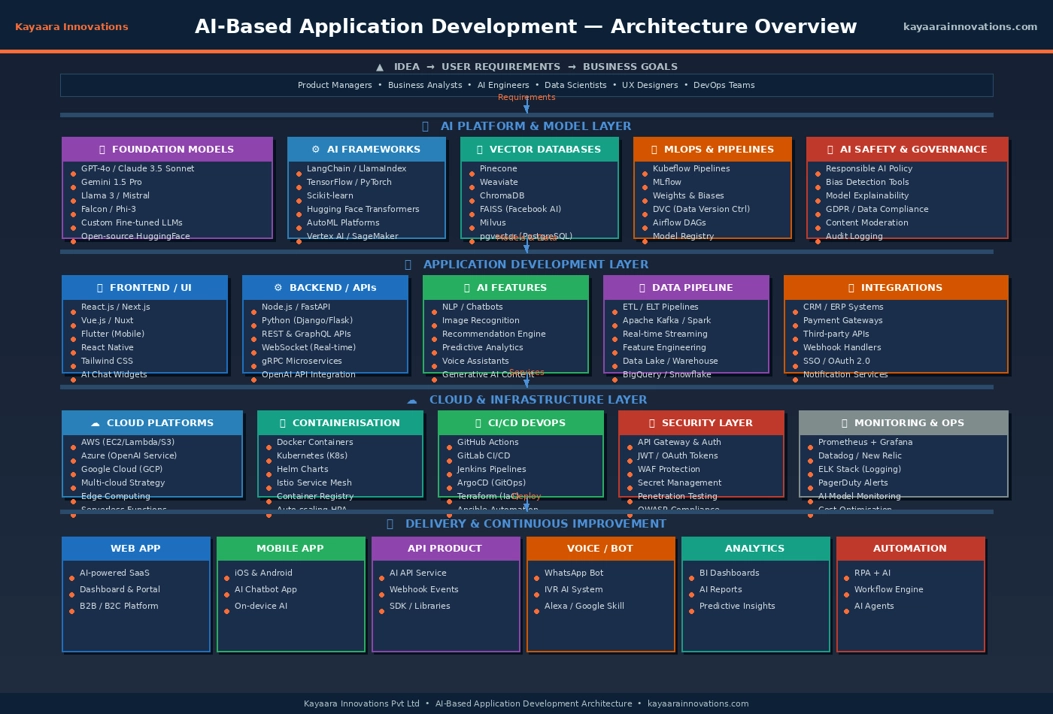 As the diagram illustrates, a complete AI application stack spans five distinct layers: the AI Platform and Model Layer (where intelligence is sourced), the Application Development Layer (where features and APIs are built), the Cloud and Infrastructure Layer (where everything runs and scales), and the Delivery Layer (where real users experience the product). Misalignment in any single layer cascades into failures across all others.
Choosing the Right AI Model and Platform :
Perhaps no decision in AI application development carries more weight than the choice of foundation model and AI platform. With dozens of options now available — from OpenAI’s GPT series to Anthropic’ s Claude, Google’s Gemini, Meta’s Llama, and hundreds of open-source alternatives — organisations are overwhelmed. Making the wrong choice here is costly: it affects performance, total cost of ownership, data privacy, vendor lock-in, and the long-term maintainability of your product.
Proprietary vs Open-Source Models :
- Proprietary Models (GPT-4o, Claude 3.5, Gemini 1.5 Pro) — offer state-of-the-art performance, easy API access, and continuous improvement by the vendor. Best for applications where quality is paramount and data privacy requirements allow external API calls.
- Open-Source Models (Llama 3, Mistral, Falcon, Phi-3) — offer full control, on-premise deployment, no usage costs at scale, and no data leaving your infrastructure. Best for sensitive industries like healthcare, banking, and government.
- Fine-tuned Custom Models — starting from an open-source base, fine-tune on your proprietary data to create domain-specific intelligence. Ideal for specialised tasks where general models underperform.
Key Platform Evaluation Criteria :
- Context Window Size — how much information can the model process in a single interaction? Larger context windows (128K+ tokens) are critical for document analysis and long-form tasks.
- Latency and Response Time — for real-time applications like customer service chatbots, response time under 2 seconds is non-negotiable.
- Cost Per Token — at scale, API costs accumulate rapidly. Model cost must be factored into your product unit economics from day one.
- Multimodal Capabilities — does your application need to process text, images, audio, and video? Ensure your model supports all required modalities.
- Data Privacy and Residency — does the API provider process your data on servers within your required jurisdiction? Critical for GDPR and RBI-regulated data.
- Rate Limits and SLAs — enterprise-grade AI applications need guaranteed uptime and throughput; validate SLAs before committing.
“Kayaara Tip: Never build your AI application tightly coupled to a single model provider. Use an abstraction layer (Lang Chain, LiteLLM) so you can swap models without rewriting your entire application.“
Data Quality — The Foundation Everything Rests On :
Artificial Intelligence does not create intelligence from nothing — it amplifies the patterns present in your data. Poor data quality is the single most common root cause of AI application failure. An organisation can invest in the most powerful GPU cluster, the most sophisticated model, and the most experienced team, and still produce a useless AI system if the underlying data is incomplete, biased, or poorly structured.
Data Challenges Organisations Face
- Data Silos — critical data spread across disconnected CRM, ERP, spreadsheet, and legacy systems with no unified access layer.
- Data Quality Issues — missing values, inconsistent formats, duplicate records, and outdated information degrade model performance dramatically.
- Insufficient Labelled Data — supervised learning models require labelled training data; acquiring high-quality labels at scale is time-consuming and expensive.
- Data Bias — training data that reflects historical biases produces AI systems that perpetuate and amplify those biases in their outputs.
- Data Privacy Constraints — personal data used for training must comply with privacy regulations; anonymisation and differential privacy techniques must be applied.
- Real-time Data Freshness — AI models trained on stale data produce outdated predictions; building real-time streaming pipelines (Apache Kafka, Flink) is essential.
Solutions: Building a Robust Data Pipeline :
- Implement a Unified Data Lake (AWS S3, Azure Data Lake, Google Cloud Storage) as the single source of truth for all raw data.
- Deploy ETL/ELT pipelines using Apache Spark, dbt, or Airbyte to clean, transform, and standardise data before it reaches your AI model.
- Use Vector Databases (Pinecone, Weaviate, ChromaDB) to store embeddings for Retrieval-Augmented Generation (RAG) applications.
- Implement data versioning (DVC) to track changes in training datasets and ensure reproducibility of experiments.
- Establish data governance policies — data catalogues, lineage tracking, and access controls — before data reaches any AI model.
“Data is not the new oil — clean, well-governed, domain-specific data is. Raw data without quality controls is not an asset; it is a liability that will corrupt your AI outputs.”
Building the Right Application Architecture :
AI-based applications have fundamentally different architectural requirements compared to traditional software systems. They are probabilistic rather than deterministic, they degrade over time as data distribution shifts, they carry significant computational costs, and they introduce unique failure modes that traditional monitoring cannot detect. Getting the architecture right from the beginning determines whether your AI application scales gracefully or collapses under production load.
Core Architectural Patterns for AI Applications :
- RAG (Retrieval-Augmented Generation) — instead of relying solely on a model’s training knowledge, retrieve relevant documents from your knowledge base in real time and inject them into the model’s context. Dramatically reduces hallucinations and keeps responses current.
- Microservices Architecture — decouple your AI inference service from your application logic and data services. This allows each component to scale independently and simplifies model updates without downtime.
- Event-Driven Architecture — use message queues (Apache Kafka, AWS SQS) to decouple AI inference from synchronous user requests. Enables asynchronous processing for compute-intensive tasks.
- Agent-Based Architecture — LLM agents that can use tools (web search, code execution, database queries, API calls) to complete complex multi-step tasks autonomously. Frameworks like LangGraph and AutoGPT enable this pattern.
- Model Gateway Pattern — a single API gateway that routes requests to different models based on task type, cost, and performance requirements. Enables model A/B testing and seamless switching.
Frontend & User Experience Considerations :
- Streaming Responses — always stream AI responses token by token rather than waiting for the complete response; dramatically improves perceived performance.
- Graceful Degradation — design fallback behaviours for when the AI model is unavailable, slow, or returns low-confidence outputs.
- Human-in-the-Loop Design — for high-stakes decisions, design workflows where AI proposes and humans approve, rather than AI deciding autonomously.
- Feedback Mechanisms — embed thumbs up/down, rating controls, and correction interfaces so users can provide feedback that improves the model over time.
Kayaara Insight: The most successful AI applications we have built use the RAG pattern combined with microservices — keeping the AI “brain” separate from business logic makes the system dramatically easier to improve and maintain over time.
AI Safety, Ethics & Responsible Governance :
As AI applications move from internal tools to customer-facing products, the stakes of getting AI governance wrong increase dramatically. A biased hiring algorithm, a hallucinating medical chatbot, or a discriminatory credit scoring model can destroy brand trust, trigger regulatory action, and cause genuine harm to real people. Responsible AI is not a box-ticking compliance exercise — it is an engineering discipline that must be designed into every AI application from the first line of code.
- Hallucination Mitigation — implement output validation, confidence scoring, and RAG to ground model responses in verified facts.
- Bias Detection and Fairness Testing — audit model outputs across demographic groups; tools like IBM AI Fairness 360 and Fairlearn provide quantitative bias metrics.
- Explainability (XAI) — for regulated industries, be able to explain why the AI made a specific decision. LIME, SHAP, and model cards are key tools.
- Content Moderation — implement input and output filtering to prevent harmful, offensive, or off-topic content in user-facing AI applications.
- Data Privacy by Design — anonymise PII before it reaches any model; implement differential privacy for training on sensitive datasets.
- Comprehensive Audit Logging — log every model input, output, and decision with timestamps and user identifiers for accountability and compliance.
- Model Version Control — track every model version in production, maintain rollback capability, and document model changes in a model registry.
“AI governance is not the responsibility of the compliance team — it is an engineering responsibility. Every developer building an AI application must understand the ethical implications of the system they are creating.”
Taking AI from Prototype to Production :
One of the most persistent frustrations in enterprise AI is the “prototype trap” — a proof of concept performs brilliantly in the lab, but the organisation cannot figure out how to deploy it reliably at scale. This is the MLOps problem. MLOps (Machine Learning Operations) is the discipline of industrialising the AI development lifecycle so that models move from experiment to production reliably, repeatedly, and maintainably.
The Complete MLOps Pipeline
- Experiment Tracking (MLflow, Weights & Biases) — log every experiment with its hyperparameters, metrics, and artefacts so that results are reproducible and comparable.
- Model Registry — a central catalogue of all trained models with their versions, performance metrics, approval status, and deployment history.
- Automated Training Pipelines (Kubeflow, SageMaker Pipelines) — trigger model retraining automatically when data distribution drift is detected or new labelled data becomes available.
- Continuous Integration for ML — run automated tests on new model versions: unit tests for data preprocessing, integration tests for API compatibility, and performance regression tests.
- Canary Deployments — deploy new model versions to a small percentage of traffic first; monitor performance before full rollout.
- Model Monitoring — track prediction distribution, feature drift, latency, error rates, and business KPIs continuously. Alert on anomalies before they affect users.
- Feedback Loops — route user corrections and ratings back into the training pipeline to continuously improve model quality.
Kayaara Framework: We mandate that every AI application we build passes through our AI Readiness Checklist — covering data quality, model performance benchmarks, security review, bias audit, and operational runbook — before any production deployment.
Cost Management and Scalability :
AI inference is computationally expensive. A product that works beautifully with ten users can generate astronomical cloud bills at ten thousand users if the cost architecture was not designed correctly from the start. Cost management and scalability planning are not afterthoughts — they are core engineering concerns in AI application development.
- Model Selection by Cost-Performance Trade-off — use the smallest model that meets your quality requirements. GPT-3.5 or Claude Haiku at a fraction of the cost often suffices for classification and summarisation tasks.
- Response Caching — cache common queries and their AI responses using Redis or similar; identical or semantically similar queries need not hit the model API.
- Prompt Optimisation — shorter, more precise prompts consume fewer tokens. Invest engineering time in prompt engineering to reduce token usage at scale.
- Async and Batch Processing — process non-time-critical AI tasks in batches during off-peak hours to reduce costs.
- Auto-scaling Infrastructure — use Kubernetes Horizontal Pod Autoscaler (HPA) to scale inference services up and down with demand; avoid paying for idle GPU capacity.
- Reserved Capacity and Committed Use Discounts — for predictable workloads, commit to reserved cloud instances (AWS Reserved Instances, Azure Reserved VM Instances) for 40-60% cost savings.
Cost Reality Check: A poorly optimised AI application serving 100,000 users per day can easily cost USD 50,000+ per month in API and compute costs. The same application, properly optimised with caching, model selection, and async processing, can cost 80% less.
How to Choose the Right AI Development Platform?
With the challenge landscape mapped, here is a practical decision framework for selecting your AI development platform. There is no universal answer — the right choice depends on your use case, team capability, budget, data sensitivity, and scale requirements.
For Rapid Prototyping and MVP Development :
- Use OpenAI API or Anthropic Claude API — minimal setup, world-class capabilities, pay-per-use pricing.
- Build with LangChain for orchestration and Streamlit or Next.js for the frontend.
- Use Pinecone or Supabase (pgvector) for vector storage.
- Deploy on Vercel, Railway, or AWS Lambda for serverless simplicity.
For Enterprise-Grade Production Applications :
- Evaluate Azure OpenAI Service (data stays in your Azure tenant) or AWS Bedrock (multi-model access).
- Implement full MLOps with MLflow, Kubeflow, and a model registry.
- Deploy on Kubernetes (EKS, AKS, GKE) with auto-scaling and multi-region redundancy.
- Implement comprehensive monitoring with Prometheus, Grafana, and dedicated LLM observability tools.
For Privacy-Sensitive or Regulated Industries :
- Deploy open-source models (Llama 3, Mistral) on-premises or in a private cloud VPC.
- Use Ollama or vLLM for efficient local model serving.
- Implement all data processing within your security boundary — no external API calls with sensitive data.
- Ensure compliance certifications (ISO 27001, SOC 2) for all infrastructure components.
For AI-Native SaaS Products :
- Design a multi-tenant architecture with proper data isolation between customers.
- Implement usage-based billing tied directly to AI inference costs.
- Build model abstraction layers to switch models as better options emerge.
- Design for continuous learning — user feedback should automatically improve model quality over time.
The Kayaara AI Development Framework :
At Kayaara Innovations, every AI application we build follows our proven 7-phase development framework. This structured approach ensures that we address every challenge systematically and deliver AI applications that perform reliably in the real world.
Phase 1: Discovery & Problem Framing
Define the specific business problem AI must solve. Not every problem benefits from AI — we rigorously validate whether the problem is tractable with available data, whether AI adds measurable value over simpler solutions, and whether the organisation has the maturity to maintain an AI system.
Phase 2: Data Audit & Strategy
Assess existing data assets, identify gaps, design collection strategies, establish data governance policies, and build the data pipeline architecture. This phase often reveals that data preparation will consume 60-70% of the total project effort.
Phase 3: Model Selection & Experimentation
Run structured experiments with multiple model candidates using consistent evaluation frameworks. Document results, costs, and trade-offs transparently so the selection decision is evidence-based, not vendor-influenced.
Phase 4: Application Architecture Design
Design the complete system architecture — AI inference layer, application services, data flows, integration points, security boundaries, and scalability model. Produce detailed architecture documents and review with all stakeholders before development begins.
Phase 5: Development & Integration
Build the application following AI engineering best practices — prompt versioning, output validation, error handling for model failures, streaming interfaces, and comprehensive test coverage including adversarial testing.
Phase 6: Safety Review & Bias Audit
Conduct a dedicated AI safety review: red-team the model with adversarial inputs, measure performance across demographic groups, verify explainability requirements, and confirm compliance with applicable regulations.
Phase 7: Production Deployment & Continuous Improvement
Deploy with progressive rollout (canary deployment), establish monitoring dashboards, configure alerts, implement feedback collection, and schedule regular model refresh cycles. An AI application is never “done” — it must continuously improve to remain effective.
Conclusion: Building the Intelligent Future :
AI-based application development is simultaneously the greatest technical opportunity and the most complex engineering challenge of our era. The organisations that approach it with the right architecture, the right data strategy, the right platform choices, and the right governance framework will build products that create lasting competitive advantages. Those that rush in without this foundation will spend enormous resources to produce systems that disappoint users, fail under production load, and expose the organisation to ethical and regulatory risk.
The good news is that the frameworks, tools, and platforms available today make high-quality AI application development more accessible than ever before. You do not need a team of PhD researchers to build a world-class AI product — you need a clear problem definition, quality data, a thoughtful architecture, the right platform choices, and experienced engineering guidance.
Ready to build your AI application the right way? Kayaara Innovations Pvt Ltd offers end-to-end AI application development services — from discovery and data strategy to production deployment and continuous optimisation. Visit kayaarainnovations.com to start your AI journey today.